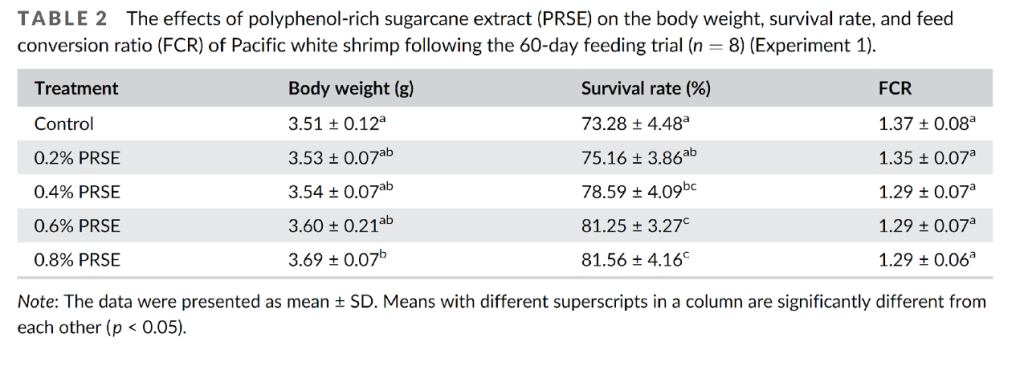
In addition to increasing the immune response of vannamei shrimp, the results of joint research between Kasetsart University – Thailand, Poly Gain Pte Ltd – Singapore, and La Trobe University – Australia also concluded that PRSE is useful for increasing the growth performance and survival rate of shrimp. The journal, originally titled Effects of Polyphenol Rich Sugarcane Extract (PRSE) on Growth Performance, Survival, Immune Responses, and Resistance to Vibrio parahaemolyticus and White Spot Syndrome Virus Infections of Pacific White Shrimp (Litopenaeus vannamei), was compiled by Parattagorn Wimanhaemin, Niti Chuchird, Tirawat Rairat et al., published through various digital scientific journal platforms in mid-December 2024. The three scientists work at the Department of Fishery Biology, Faculty of Fisheries, Kasetsart University, Thailand.
The report stated that polyphenol-rich sugarcane extract (PRSE) is a sugarcane product obtained from the sugar refining industry and has the potential to be used as a feed additive for livestock. The purpose of this study was to evaluate the effects of PRSE on growth performance, survival, immune response, and resistance to Vibrio parahaemolyticus and white spot syndrome virus (WSSV) infections of whiteleg shrimp, (Litopenaeus vannamei).
In Experiment 1, post-larval (PL) shrimp were randomly divided into five groups (8 replicates/group and 80 shrimp/tank) and fed commercial feed supplemented with PRSE at rates of 0 (control), 0.2, 0.4, 0.6, and 0.8% of the diet four times/day for 60 days to evaluate body weight, survival rate, and immune function.
In Experiment 2, juvenile shrimp from Experiment 1 were randomly redistributed into six groups (four treatment groups as in Experiment 1, positive control, and negative control with 3 replicates/group and 30 shrimp/tank) and challenged with V. parahaemolyticus or WSSV via immersion (105 colony-forming units/mL) and oral (feeding with infected tissue), respectively, to evaluate disease resistance. The experiment showed that the shrimp body weight for the 0.8% PRSE group was significantly greater than the other groups, and those treated with 0.4%–0.8% PRSE showed significant increases in survival, total hemocyte count, phagocytic activity, phenol oxidase activity, and superoxide dismutase (SOD) activity compared with the control.